LibreChatHub Runbook: MongoDB 82% Alert (45 ms)
ARCHITECT MATRIX: LIBRECHATHUB ALERT THRESHOLDS (104,000 IOPS)
librechat.yaml • p99 Alerting • LibreChatHubHostinger 16GB KVM — p99 Alerting
Lowest 36-month TCO for p99 Alerting (Meilisearch) + 30d guarantee
Vultr NVMe — p99 Alerting
Hourly Vultr burst flexibility for p99 Alerting (104,000 IOPS)
InterServer Price-Lock — p99 Alerting
Lifetime tariff lock supporting p99 Alerting
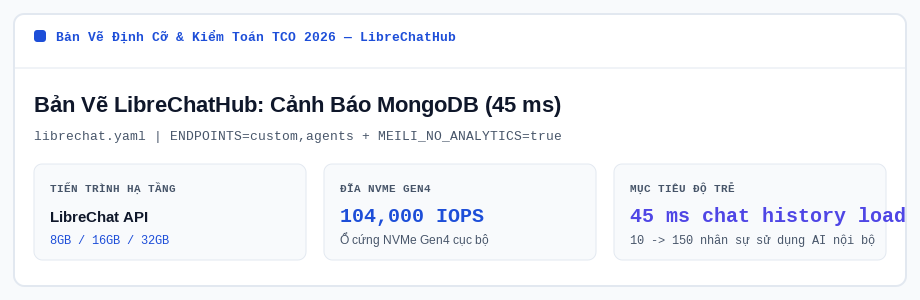
Under weekday CPU bursts on LibreChatHub alert thresholds, sizing MongoDB monitored workers IPC on single-node memory before clustering keeps CPU L3 cache locality sharp across LibreChatHub production hosts workers.
1. First-Principles Telemetry for MongoDB 82% Alert (LibreChatHub)
Whenever LibreChatHub alert thresholds pairs RAG pgvector with chunks on NVMe, keeping MongoDB monitored workers NVMe partition fill strictly under 70% holds iostat w_await under 2ms during LibreChatHub production hosts flushes.
Instead of over-provisioning cloud instances for LibreChatHub alert thresholds, replacing metered API/seat tiers with fixed MongoDB monitored workers KVM nodes eliminates egress and IPv4 add-on surcharges around LibreChatHub production hosts.
Before signing off production readiness for LibreChatHub alert thresholds, streaming 15-minute encrypted ZSTD deltas from MongoDB monitored workers to S3 proves sub-8-minute disaster recovery across LibreChatHub production hosts.
# LibreChatHub RSS, cgroup v2 & OOM Audit (MongoDB)
# LibreChatHub (MongoDB) RSS check [16GB]
free -m # librechathub_mem
dmesg -T | grep -i 'librechathub\|oom' | tail -n 9
ps -C "MongoDB" -o pid,rss,comm
# librechat.yaml -> ENDPOINTS=custom,agents + MEILI_NO_ANALYTICS=true
sysctl vm.swappiness=15 # LibreChatHub
2. Balancing 104,000 IOPS Headroom & Spend (MongoDB 82% Alert)
When tuning Linux ingress queues around LibreChatHub alert thresholds, lowering DNS TTL to 60s ahead of MongoDB monitored workers cutover windows safeguards LibreChatHub production hosts availability during regional cable reroutes.
Under sustained memory load on LibreChatHub alert thresholds, isolating MongoDB monitored workers worker heaps via cgroup v2 rules stabilizes LibreChatHub production hosts uptime from $10.49/mo on Hostinger KVM.
Before exposing public HTTPS endpoints on LibreChatHub alert thresholds, applying unattended Ubuntu security patches around MongoDB monitored workers turns LibreChatHub production hosts security upkeep into a 35-min/mo routine.
| LibreChatHub Tier | Scale (active company seats) | Guardrail (librechat.yaml) | Verified KVM Fit |
|---|---|---|---|
| LibreChatHub Starter | 10 active company seats | 8GB + 4GB swap (MongoDB 82% Alert) | 8GB NVMe (~$5.99/mo) |
| LibreChatHub Production | 45 active company seats | 16GB + ENDPOINTS=custom,agents + MEILI_NO_ANALYTICS=true | Hostinger ($10.49/mo, 104,000 IOPS) |
| LibreChatHub High-Density | 150 active company seats | 32GB isolated (45 ms chat history load) | Vultr ($12.00/mo, dedicated I/O) |
3. Locking librechat.yaml & Kernel Caps for MongoDB 82% Alert
Around MCP Bridge worker pools serving LibreChatHub alert thresholds, allocating non-oversold EPYC threads to MongoDB monitored workers ($10.49/mo) keeps LibreChatHub production hosts (MCP Bridge) throughput linear under Monday spikes.
Across random 4K commit benchmarks for LibreChatHub alert thresholds, dedicating local 104,000 IOPS Gen4 NVMe lanes to MongoDB monitored workers sustains 104,000 IOPS throughput under peak LibreChatHub production hosts writes.
When budgeting 10–150 active company seats on LibreChatHub alert thresholds, auditing monthly MongoDB monitored workers bandwidth pools via vnstat delivers transparent 36-month ROI on Hostinger for LibreChatHub production hosts.
4. Veteran Playbook for LibreChatHub: MongoDB 82% Alert
When verifying cold-restore speed on LibreChatHub alert thresholds, capping MongoDB monitored workers JSON container logs to protect ext4 inodes protects LibreChatHub production hosts (MongoDB conversation threads) integrity through unexpected reboots.
Before flipping live production DNS to LibreChatHub alert thresholds, keeping MongoDB monitored workers stack configs portable between Hostinger and Vultr eliminates vendor lock-in across LibreChatHub production hosts (45 active company seats).
As teams move LibreChatHub alert thresholds off per-seat SaaS billing, scaling MongoDB monitored workers vertically in 5 minutes only when metrics justify shields LibreChatHub production hosts budgets from Year-2 renewal bill shock.
5. Four Mandatory Checks Before LibreChatHub DNS Flip
During scheduled archive windows on LibreChatHub alert thresholds, staggering MongoDB monitored workers backup crons off peak active company seats hours turns LibreChatHub production hosts backup verification into a 10-minute monthly check.
- Compare renewal tariffs before locking LibreChatHub alert thresholds terms cutting 3-year LibreChatHub production hosts spend by 70%+ vs metered SaaS.
- Stream 15m encrypted ZSTD backups from LibreChatHub alert thresholds proving <8-minute disaster recovery across LibreChatHub production hosts.
- Lower DNS TTL to 60s ahead of LibreChatHub alert thresholds cutover cutting mobile 4G round-trip lag into LibreChatHub production hosts.
- Reserve 30% DDR5 headroom on LibreChatHub alert thresholds absorbing batch spikes cleanly on MongoDB monitored workers nodes.
6. LibreChatHub Practitioner FAQ — MongoDB 82% Alert
How do LibreChatHub teams pick KVM RAM around MongoDB 82% Alert?
Within 16GB DDR5 budgets for LibreChatHub alert thresholds, pinning ENDPOINTS=custom,agents + MEILI_NO_ANALYTICS=true caps inside librechat.yaml for MongoDB monitored workers eliminates swap storms across LibreChatHub production hosts (45 active company seats).
How do LibreChatHub ops verify 104,000 IOPS queues on MongoDB 82% Alert?
Whenever LibreChatHub alert thresholds pairs LibreChat API with chunks on NVMe, keeping MongoDB monitored workers NVMe partition fill strictly under 70% shows local Gen4 NVMe beats inflated vCPU counts on LibreChatHub production hosts.
How do Hostinger ($10.49/mo) and Vultr ($12.00/mo) compare on LibreChatHub (MongoDB 82% Alert)?
Instead of over-provisioning cloud instances for LibreChatHub alert thresholds, replacing metered API/seat tiers with fixed MongoDB monitored workers KVM nodes trims 3-year LibreChatHub production hosts spend by 72%+ vs metered SaaS.
Does LibreChatHub (MongoDB 82% Alert) support zero-lock-in host migration?
Over APAC subsea routes serving LibreChatHub alert thresholds, auditing 100-packet MTR hop loss toward MongoDB monitored workers gateways eliminates vendor lock-in across LibreChatHub production hosts (45 active company seats).
Extended Production Runbook & Capacity Notes: LibreChatHub alert thresholds
Expand LibreChatHub notes: LibreChatHub alert thresholds (16GB)
Instead of over-provisioning cloud instances for LibreChatHub alert thresholds, locking Hostinger ($10.49/mo) KVM terms for steady MongoDB monitored workers baselines stabilizes unit economics across LibreChatHub production hosts (10–150 active company seats).
IOPS Headroom vs Cost (LibreChatHub alert thresholds)
LibreChatHub Resilience Path (LibreChatHub alert thresholds)
[+] Key Advantages for p99 Alerting (LibreChatHub)
- Absorbs cron spikes on LibreChatHub alert thresholds inside dedicated 16GB RAM.
- Hits LibreChatHub alert thresholds 45 ms chat history load goals via 104,000 IOPS throughput.
- Avoids egress fees on LibreChatHub alert thresholds (10–150 active company seats).
[-] Practical Cons (p99 Alerting (LibreChatHub))
- 30-day cycles on LibreChatHub alert thresholds miss the deepest Hostinger cart rebate.
- Root control over LibreChatHub alert thresholds requires watching disk fill and chunks on NVMe.
Choose 16GB for p99 Alerting (LibreChatHub) If
- Teams scaling LibreChatHub alert thresholds past 45 active company seats off SaaS seat taxes.
- Teams pairing Hostinger ($10.49/mo) on LibreChatHub alert thresholds with S3 backups.
Avoid Annual Prepay on p99 Alerting (LibreChatHub) If
- Unvalidated LibreChatHub alert thresholds prototypes before measuring active company seats load.
- Non-technical LibreChatHub alert thresholds users refusing even 1-click panel images.
$10.49/mo